

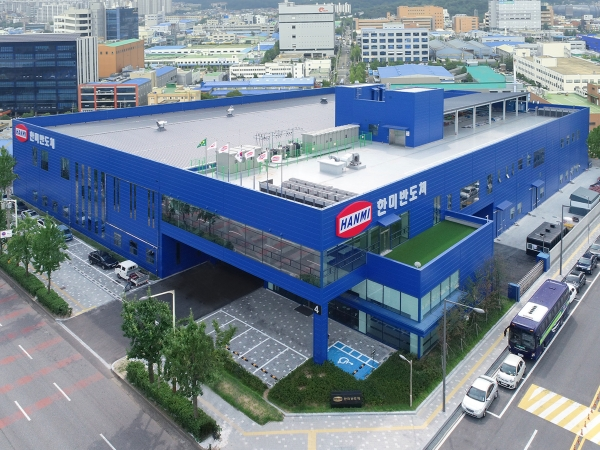
Hanmi Semiconductor to Invest ₩100 Billion to Develop Hybrid Bonder
Hanmi Semiconductor announced on the 25th that it will invest 100 billion won in hybrid bonding technology. Hanmi Semiconductor plans to launch hybrid bonder equipment by the end of 2027.
Hanmi Semiconductor is investing a total of KRW 100 billion to build a two-story hybrid bonder factory with a total floor area of 4,415 pyeong (14,570.84 m2) in the Juan National Industrial Complex in Seo-gu, Incheon. Completion is targeted for the second half of next year. With this investment, Hanmi Semiconductor will have a production line totaling 27,083 pyeong (89,530 m2).
The hybrid bonder factory plans to produce next-generation equipment, including a TC bonder for high-spec high-bandwidth memory (HBM), a fluxless bonder, a big die TC bonder for AI 2.5D packages, and a hybrid bonder (for HBM and logic semiconductor XPU).
Intel cuts staff and scraps fab expansion plan
Intel CEO Lip Bu-tan announced in a conference call announcing the company’s second-quarter earnings on the 24th (local time) that the company would significantly scale back its foundry construction plans and cut 15% of its workforce.
Intel has canceled its planned foundry fab projects in Germany and Poland and decided to consolidate its test and assembly operations in Vietnam and Malaysia. It has also decided to slow the construction of a state-of-the-art fab in Ohio, USA, depending on market demand and securing large customers.
In addition, the total number of employees will be reduced from 124,000 in 2023 to 109,000 at the end of last year, and will be further reduced to 75,000 by the end of this year.
OCI Enters the High-Value-Added Semiconductor Material “Isotropic Artificial Graphite Pitch” Business
OCI announced on the 21st that it had begun the initial delivery of pitch for isotropic artificial graphite, which is essential for semiconductors and advanced materials, to Ibiden Graphite Korea Co., Ltd., the only isotropic artificial graphite manufacturer in Korea, on the 15th.
Isotropic artificial graphite is a high-temperature, high-purity material with excellent electrical conductivity. Its properties are stable even at high temperatures, and it is used as a mold material in various industrial fields, enabling the melting and casting of key materials.
It is widely used in the semiconductor field, especially in containers that melt polysilicon into ingots during the semiconductor wafer manufacturing process and in components used to heat wafers during the semiconductor deposition process.
Tsinghua University in China develops photoresist for EUV
China’s Tsinghua University has independently developed EUV (extreme ultraviolet) photoresist, a key material for next-generation advanced semiconductor processes, leading to assessments that a substantial breakthrough has been made in the materials field, which was considered a “bottleneck” in the semiconductor industry.
Researchers at Tsinghua University recently announced the development of a new photoresist formulation based on poly(Te-Oxane). This material is optimized for EUV lithography using a 13.5nm wavelength and has been shown to meet high sensitivity, high resolution, and high EUV absorption. The results of this research were published in the international journal Science Advances on July 16.
Hoemyeong Industries is investing 67.3 billion won to build a new semiconductor material production plant in Asan.
Hoemyeong Industry is investing 67.3 billion won to build a new factory in Yeong-in-myeon, Asan, South Chungcheong Province, to produce core semiconductor materials.
According to the MOU between Asan City and Hoemyeong Industries, Hoemyeong Industries will build a new semiconductor glass substrate manufacturing plant in Asan and hire approximately 1,200 local employees. Asan City will provide administrative support to Hoemyeong Industries to ensure smooth business operations.
Founded in 1994, Hoemyeong Industry operates four domestic plants in Cheonan, Gumi, Sacheon, and Suncheon, and four overseas plants in the United States, China, Japan, and Vietnam. The company manufactures secondary battery materials and precision cleaners for semiconductors and displays.
MT Holding, a semiconductor quartz manufacturer, is gearing up for a US listing.
Wonik QnC, a semiconductor materials company under the Wonik Group, and MT Holding (formerly MOMQ), a US quartz materials company jointly owned by domestic private equity fund (PEF) SJL Partners, have entered into full-scale preparations for an initial public offering (IPO) next year.
According to investment banking (IB) industry sources on the 22nd, Wonik QnC and SJL Partners recently selected Bank of America (BoA) and Citi Global Markets Securities as joint underwriters and began preparations for MT Holding’s initial public offering (IPO). The company is currently weighing listings on U.S. stock markets, including the NASDAQ and New York Stock Exchange, with the goal of an IPO in the first half of next year.
MT Holding’s core business is high-purity quartz products. Semiconductor manufacturing processes require the ability to withstand extreme high temperatures and high-purity conditions, driving growing demand for high-value precision quartz materials such as quartz crucibles, tubes, and rings. MT Holding holds a leading position in this field, demonstrating both technological prowess and market share.
Rebellion and Coasia Semiconductor Develop Next-Generation AI Chiplets, Building an Ecosystem
Rebellion announced on the 23rd that it has signed a contract with Coasia Semiconductor, a company specializing in system semiconductor design, to develop and supply artificial intelligence (AI) chiplets based on Rebellion’s next-generation AI semiconductor, REBEL.
Rebellion develops AI chiplets and software solutions by leveraging Coasia Semi’s 2.5D silicon interposer and advanced package analysis, development, and manufacturing technologies. Compared to conventional single-chip (SoC) architectures, this chiplet technology offers superior design flexibility, yield, power, and performance optimization, making it a key technology for data center AI servers and high-performance computing (HPC) environments.

Tesla falters in the US electric vehicle market, while GM rises, overtaking Hyundai to take second place.
According to an electric vehicle market analysis report released on the 23rd (local time) by Kelley Blue Book, a subsidiary of U.S. market research firm Cox Automotive, electric vehicle sales in the U.S. in the second quarter of this year decreased by 6.3% compared to the same period last year, recording 318,390 units.
By manufacturer, Tesla and GM saw particularly significant performance changes. Tesla sold 143,535 units in the second quarter, a 12.6% decrease from the same period last year (164,264 units).
Meanwhile, GM’s combined sales of its Cadillac (11,795 units), Chevrolet (28,453 units), and GMC (6,032 units) brands reached 46,280 units, a 111% increase compared to the same period last year (21,930 units).
Chaebi, the leader in rapid electric vehicle charging, applies for preliminary review for listing on KOSDAQ.
Chaebi, Korea’s leading rapid charging infrastructure provider (CPO) for electric vehicles, announced on the 22nd that it had submitted a preliminary application for listing on the KOSDAQ to the Korea Exchange the previous day. Since its founding in May 2016, Chaebi has achieved vertical integration across the entire electric vehicle charging business value chain, from charger development and manufacturing to installation, operation, and aftercare.
It ranks first in the private rapid charging market share and holds more than half of the government’s public rapid charging capacity.
Yumicore Signs Investment Agreement with South Chungcheong Province for Battery Materials Plant in Cheonan
Yumicore announced on the 25th that it signed a strategic business agreement with South Chungcheong Province on the 24th in Paris, France to increase the production capacity of its Cheonan battery materials plant and strengthen the advanced industrial ecosystem in South Chungcheong Province.
This business agreement is part of Umicore’s strategy to expand its production capacity for high-nickel cathode materials for electric vehicles at its Cheonan plant, which was announced at its Capital Market Day in March.
Established in 1999 in the Cheonan 3rd Industrial Complex in South Chungcheong Province, Umicore has been producing Korea’s first cathode materials for secondary batteries. It currently operates the company’s largest battery materials research and development (R&D) center and three production facilities in Cheonan.
KG A begins full-scale conquest of the US and Japanese waste battery recycling markets.
KG A announced on the 24th that it has launched sales operations for its used battery restorer in the United States and Japan. The newly launched used battery restorer specializes in lead-acid batteries, and KG A has targeted the United States and Japan, traditionally considered powerhouses in the lead-acid battery market, as its primary target markets.
KG A’s restorer was developed over approximately three years and is optimized for lead-acid battery restoration, incorporating the latest technologies such as artificial intelligence (AI) and a battery management system (BBMS).
Korea’s largest ESS bidding war concludes this week… Battery 3 companies LFP and NCA clash
The Korea Power Exchange, under the Ministry of Trade, Industry and Energy, will finalize its document review for the 2025 first ESS central contract market competitive bidding process, announced in May, and announce the preferred bidder by the end of this month at the latest. The bidding volume, at 540 MW (megawatts), is the largest ever for a single domestic project.
LG Energy Solution participated in this bid with its pouch-type LFP. SK On also participated with its pouch-type LFP, which boasts competitive pricing and superior fire safety. Samsung SDI participated with its prismatic NCA. While NCA is typically priced higher than LFP, Samsung SDI reportedly submitted an aggressive bid to minimize any price disadvantage.
The battery cathode materials market is expected to see steady growth for silicon amidst the strength of graphite.
According to the report, ‘2025 Current Status and Outlook of Lithium-ion Battery Silicon Anode Materials Technology’ recently published by SNE Research on the 21st, the share of silicon anode materials in the lithium-ion battery anode material market is expected to increase to 4% in 2030 and 6% in 2035.
The use of silicon anode materials is expected to increase to 164,000 tons in 2030 and 295,000 tons in 2035.
Last year, the silicon anode market reached approximately 26,000 tons, accounting for only 1.3% of the total anode market of 1.968 million tons. While lithium iron phosphate (LFP) battery cathode materials are showing strength, low-cost graphite is also gaining ground, leading to a slight slowdown in the use of silicon anodes.
LG-SK Battery’s feud thaws… Copper foil supply discussions underway
The “battery feud” between LG and SK is showing signs of thawing. There’s growing speculation that SK Nexilis could supply large quantities of copper foil, a key battery material, to LG Energy Solution. An SK Nexilis representative stated, “Positive discussions are taking place between the two companies,” but added, “The specific contract size and whether it will be concluded have not been finalized.”
SK and LG engaged in a trade secret and patent infringement lawsuit related to battery technology from 2019 to 2021. Since then, cooperation between the two companies in the battery business has been limited.

PwC: “Running Smartphone SDVs to Begin Commercialization Within 1-2 Years”
The software-centric vehicle (SDV) market, often referred to as a “running smartphone,” is expected to reach full commercialization within the next one to two years. Analysis predicts that the SDV market will grow at a 34% annual rate as the entire vehicle is managed by software (SW) and the software ecosystem expands.
On the 24th, PwC Consulting published a report titled ‘SDV 2.0: The Next Momentum in the Automotive Industry’ containing these contents.
SDV defines a vehicle as a high-performance computer. Once converted to SDV, vehicles can be updated over-the-air (OTA) like smartphones, allowing for fixes and repairs. IDTechEx, a global market research firm, projects that the SDV market will grow at an average annual rate of 34%, from $28 billion (approximately KRW 38.492 trillion) in 2023 to $700 billion in 2034.
Nextchip strengthens its robotics team, including the installation of a Hyundai robot.
Nextchip, a company specializing in automotive semiconductors, announced on the 25th that it is strengthening its dedicated robotics division and accelerating its entry into the robotics market.
Nextchip is leveraging its image processing and transmission technology, developed through automotive semiconductor development, to target the rapidly growing robotics market. Moving beyond its traditional automotive-centric business structure, the company is expanding its application areas to include industrial robots and accelerating its market entry through the development of related sensor modules and system-on-module (SoM) products.
This strengthening of the dedicated organization is yielding tangible results. Hyundai Motor Company’s small mobility platform, Mobed, scheduled for release by the end of the year, will incorporate the company’s camera module chips.
Musk: “Tesla’s Future Is Robotaxis and Robots, Not Electric Vehicles”
According to the Wall Street Journal (WSJ) on the 24th (local time), in a call with Wall Street the previous day, CEO Musk emphasized that Tesla should focus on its achievements in new areas such as self-driving robotaxis rather than its poor financial performance, and claimed that these technologies could help Tesla become “the most valuable company in the world.”
Tesla’s autonomous driving initiatives, including Robotaxi and the Optimus robotaxi, are still in their early stages. Tesla launched a Robotaxi service in Austin, Texas, in June, with an invitation-only service. Initially, it operated in a limited area, avoiding busy intersections, but starting this month, the service area has expanded to downtown Austin. The fare has also increased from $4.20 to $6.90, though a safety officer remains in the passenger seat.
Google DeepMind Unveils Self-Learning Table Tennis Robot
Google DeepMind, Google’s artificial intelligence (AI) division, has unveiled a “table tennis robot.” On the 21st (local time), DeepMind unveiled the “table tennis robot,” which uses two robotic arms to hit a table tennis ball, in the IEEE Spectrum, a scientific journal published by the Institute of Electrical and Electronics Engineers (IEEE).
The released video shows a scene where a robotic arm moves two-dimensionally along a rail on both sides of a table tennis table and rallies by hitting a ball passed by an opposing robotic arm.
SureSoftTech Makes Strategic Investment in Blick to Secure Future Vehicle and AI Robot Technology
SureSoftTech announced on the 25th that it has made a strategic equity investment in BLLIC, a company with world-class digital twin and physical AI technologies. BLLIC possesses proprietary technology that precisely and automatically digitizes indoor spaces using AI and simultaneously generates indoor positioning data. Additionally, the company boasts a range of technologies, including: ▲AI-based 3D monitoring solutions ▲robot and augmented reality (AR)-based space guidance platforms ▲lightweight smart building creation solutions.
The company is led by CEO Cho Kyu-seong, who holds a Ph.D. in Computer Science from KAIST. Cho is an expert who has overseen the development of mobile AR and simultaneous localization and mapping (SLAM) technologies at Samsung Electronics, the Electronics and Telecommunications Research Institute (ETRI), and Maxt. The core research team also has practical experience and technical expertise in 3D vision and spatial recognition.

LGD: Large OLED panel shipments to reach mid-6 million units this year, up year-over-year
Kim Sung-hyun, LG Display’s Chief Financial Officer (CFO), said in a conference call announcing the company’s second-quarter earnings on the 24th that the company expects large-scale organic light-emitting diode (OLED) panel business this year to ship “annual panels in the mid-6 million units, an increase from the previous year.”
CFO Kim said, “OLED panels are recognized for their differentiated value compared to liquid crystal displays (LCDs), and their price acceptability is approaching a range that the market can accept.” He added, “Not only OLED TV monitor panel shipments, but also sales of complete TV sets (TVs) are increasing compared to the same period last year.”
IT Chem: “Pharmaceuticals, OLED, and Advanced Chemical Materials Platforms”
At the IPO press conference held in Yeouido, Seoul on the 22nd, IT Chem CEO Kim In-gyu (pictured) said, “It may be a bit unfamiliar for one company to manufacture different materials such as pharmaceuticals and organic light-emitting diodes (OLEDs), but the core manufacturing technology and equipment processes are not very different,” adding, “I am confident that we will continue to grow steadily with these two different portfolios.”
Founded in 2005, IT Chem is a contract development and manufacturing organization (CDMO) for precision chemical materials. It manufactures materials used in displays and pharmaceuticals. Last year, the company recorded consolidated sales of KRW 62.2 billion and operating profit of KRW 6.4 billion. The average sales growth rate over the past three years was 28.3%, and operating profit increased approximately tenfold. Pharmaceuticals accounted for the largest portion of sales at 61%, while OLED, OPC (printer photoresist), and electronic materials accounted for another 39%.
Source: kipost.net