

Hanmi Semiconductor Launches BOC COB Bonder, Supplying to US Semiconductor Companies
Hanmi Semiconductor announced on the 27th that it has launched the world’s first ‘BOC COB bonder’ and will supply it to global memory customers.
The new product is the industry’s first “two-in-one” bonding equipment capable of producing both “board-on-chip (BOC)” and “chip-on-board (COB)” processes in a single unit. It will be used in the production of GDDR graphics DRAM and enterprise SSDs (eSSDs). This BOC COB bonder is expected to be deployed at Micron’s Gujarat, India, plant.
BigTech Signs MOU with US GaN Semiconductor Company Nxbeam
Bigtech, a defense electronic warfare and RF (radio frequency) specialist, announced on the 27th that it has signed a strategic cooperation memorandum of understanding (MOU) with Nxbeam, a US semiconductor company that possesses GaN (gallium nitride)-based high-power RF millimeter wave (mmWave) semiconductor and amplifier design technology.
According to the company, this agreement is part of a strategic collaboration to secure core high-power RF semiconductor technologies applicable to next-generation electronic warfare and satellite communication systems and to strengthen the foundation for self-reliance in defense semiconductor technology.
Nxbeam manufactures semiconductors utilizing the GaN semiconductor manufacturing facility (fab) of Northrop Grumman, a U.S. defense contractor with GaN semiconductor manufacturing capabilities. It possesses the design capabilities for ultra-high-frequency, high-power semiconductors required in the satellite communications and defense electronics industries.
SKC secures KRW 1 trillion in funding to secure a lead in the semiconductor glass substrate market.
SKC announced on the 26th that its board of directors had approved a paid-in capital increase of approximately 1 trillion won. This measure aims to accelerate future business expansion, including semiconductor glass substrates, and strengthen financial soundness.
On this day, SK Corporation (40.64% stake), the largest shareholder, also announced its participation in the oversubscription (120% of the allocated quantity) based on the growth potential of SKC’s semiconductor materials business.
Approximately 60% of the funds secured through this capital increase, or approximately KRW 590 billion, will be invested in product development for Absolix, a semiconductor glass substrate subsidiary. Absolix has recently been making progress in product development targeting global big tech companies. The company is concentrating its expertise in engineering under the leadership of new CEO Kang Ji-ho, a former Intel and SK Hynix executive.
ASML prepares for next-generation EUV equipment deployment
ASML, the world’s largest semiconductor equipment company, is ready to supply next-generation semiconductor exposure equipment, Reuters reported on the 27th.
This product, called ‘High-NA EUV’ equipment, is said to be able to print circuits more precisely than previous EUV equipment, thereby increasing the integration of high-precision chips such as artificial intelligence (AI) semiconductors.
It could also simplify the production process by eliminating the need to print complex chip circuits multiple times, Reuters reported.
Meta to Purchase AMD AI Chips in Bulk… “Contract Worth at Least 144 Trillion Won”
According to the Wall Street Journal (WSJ) and the Financial Times (FT), Meta and AMD signed a contract on the 24th (local time) to purchase the latest chip MI450 in an amount sufficient to build a 6 gigawatt (GW) data center over the next five years.
While the exact deal figure wasn’t disclosed, AMD said it could generate “hundreds of billions of dollars in revenue per gigawatt.” The Wall Street Journal estimated the deal at “more than $100 billion (KRW 144.34 trillion).”
Foreign media interpreted Meta’s move that day as an attempt to reduce its excessive dependence on Nvidia, the leading AI company.
Intel and Sambanova Collaborate for Multiyear Expansion of AI Inference Market
Intel announced on the 24th (local time) a multi-year collaboration with AI infrastructure startup Sambanova to expand the AI inference market. The goal is to provide highly scalable AI inference services by combining Sambanova’s SN50 AI inference-dedicated chip with Intel Xeon processors and Intel GPUs.
The SN50, a new AI inference chip unveiled by Sambanova, increases processing speed, including token generation per second, by up to five times compared to GPUs such as Nvidia, while lowering the total cost of ownership (TCO) by 30%.
Sambanova explained that the SN50 is optimized for workloads that require autonomous model execution and interaction, such as agentic AI.
President Roh Tae-moon: “Micron’s 60% Report Is False…Galaxy S26’s Main Product Will Be Samsung Memory”
“The Galaxy S26 series uses Samsung semiconductor memory for the majority of its components.”
Samsung Electronics DX Division President Roh Tae-moon made these remarks regarding the proportion of DRAM adoption at a press conference held after the Galaxy Unpacked 2026 event in San Francisco, USA on the 25th (local time). This was a response to an article in foreign media the same day regarding the “60% adoption of Micron DRAM.”
President Roh, who emphasized the stabilization of the parts supply chain, also spoke about the reason behind the re-adoption of Samsung Electronics’ own AP, the Exynos, for the Galaxy S26 series after two years. In this series, Samsung Electronics installed Exynos in both the standard and Plus models, depending on the region.
Stellantis, tightening its belt, is adopting Chinese electric vehicles.
Citing sources, Bloomberg reported on the 26th (local time) that Stellantis is considering expanding the scope of its cooperation with Chinese company Leap Motor, in which it holds a partial stake, to utilize its electric vehicle platform.
According to reports, negotiations between the two companies are currently in the early stages, with the goal of reaching an agreement within the year.
In 2023, Stellantis invested €1.5 billion (approximately KRW 2.5 trillion) in Leap Motor, currently holding a 20% stake. It also owns a 51% stake in Leap Motor International, a joint venture with Leap Motor. Leap Motor models are currently being sold in Europe through its own dealership network.
Tesla’s price cuts have led to a sharp decline in used electric vehicle prices.
According to K-Car, a directly managed used car platform company, on the 26th, the average market price of approximately 740 models released within the past 10 years in circulation in the domestic used car market was analyzed and the prices of major electric vehicles are expected to fall across the board.
The Juniper Model Y is expected to decline by -3.2%, the Model Y by -2.6%, and the Model X by -1.4%. This analysis suggests that the decline in new car prices is putting downward pressure on used car prices.
The price-cutting competition is spreading to other brands. The new Kia EV6 is expected to see a 4.6% drop, the EV4 a 2.4% drop, and the Volvo EX30, which recently lowered its price, is also expected to see a 1.3% drop. Tesla previously cut the price of its Model 3 Standard RWD to 41.99 million won.
SK Ong and POSCO Sign Agreement to Purchase and Supply Lithium for 400,000 Electric Vehicles by 2028
On the 25th, SK On and POSCO Group announced that they had signed a contract the previous day to supply up to 25,000 tons of lithium from this year to 2028. This amount is enough to produce batteries for approximately 400,000 electric vehicles.
POSCO Argentina announced this is its largest supply contract since establishing a commercial lithium production system in Salta Province, Argentina, in 2024. POSCO plans to supply lithium to SK On in the second half of this year after completing “4M certification,” which verifies material stability and production capacity.
Phil Energy invests in US solid-state battery company Factorial.
Secondary battery equipment manufacturer Phil Energy announced on the 26th that it has completed a strategic equity investment in U.S. solid-state battery company Factorial.
Phil Energy plans to collaborate with Factorial to enhance its next-generation battery process technology and participate in the all-solid-state battery supply chain. With this investment, Phil Energy has secured the right to supply Factorial with all-solid-state battery assembly equipment. Using Phil Energy’s advanced process technology, Factorial plans to scale its current pilot-level manufacturing process to mass production.
J.O. and British advanced materials company Levidian sign MOU to commercialize graphene.
Carbon nanotube (CNT) specialist J.O announced on the 26th that it has signed a memorandum of understanding (MOU) with British advanced materials company Levidian for research, development, and production of graphene.
According to the company, JEO has been recognized for its technological prowess and quality competitiveness through mass production of carbon nanotubes in Korea. This agreement is described as a strategic move to expand its business into graphene, a next-generation core material, leveraging its expertise in mass-producing CNTs.
Levidian is a Verified Graphene Producer certified by the Advanced Carbons Council, a global trade association for carbon materials. Levidian’s modular “LOOP” technology simultaneously decomposes methane to produce graphene nanoplatelets (GNPs) and clean hydrogen.
GI Tech Localizes VCM Actuator, a Key Battery Processing Device
G.I.Tech announced on the 25th that it has completed the development of a domestically produced intermittent coating actuator based on a voice coil motor (VCM), a key component in the battery electrode process, and is moving to expand its market.
The VCM actuator is a device based on permanent magnets and coils that utilizes the Lorenz force to perform high-speed, high-precision linear motion. It controls slurry discharge in the slot die of the battery electrode process at the nanometer level, determining coating uniformity and pattern precision. This technology is considered a key factor directly related to battery capacity, lifespan, and safety.
Electric vehicle separator loading capacity grows 40%… Chinese companies continue to dominate.
According to SNE Research, an energy market research firm, on the 11th, the total amount of separators used in pure electric vehicles (EVs), plug-in hybrid vehicles (PHEVs), and hybrid vehicles (HEVs) registered worldwide from January to December was tallied at 18.657 billion m2.
During the same period, markets excluding China saw a 33.1% year-on-year increase to 5.24 billion square meters. Chinese companies continued their dominance, holding over 90% of the overall market. As of the fourth quarter of last year, Korea held a 3.2% share, while Japan held a 5.2% share.
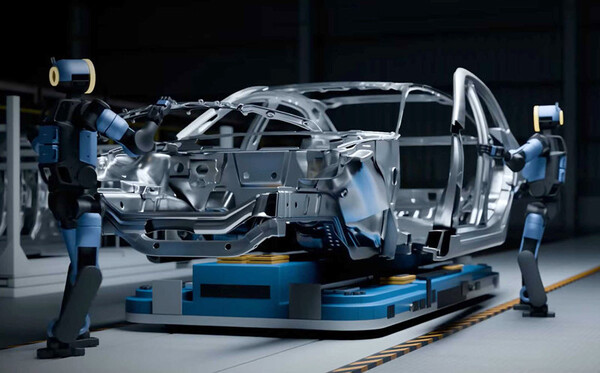
Hyundai Motor to Build AI, Robotics, and Hydrogen Future Base in Saemangeum, Investing KRW 9 Trillion
On the 27th, Hyundai Motor Group signed an investment agreement (MOU) with the government and Jeollabuk-do Special Self-Governing Province at the Gunsan Saemangeum Convention Center in Jeollabuk-do for the ‘Fostering of Advanced Robot and Hydrogen Industries in Saemangeum and the Creation of an AI Hydrogen City.’
According to this agreement, Hyundai Motor Group will make a large-scale investment of 9 trillion won in a 1,124,000 square meter (approximately 340,000 pyeong) site in Saemangeum, North Jeolla Province, starting this year.
Looking at the specifics of the investment, the group will first invest 5.8 trillion won to build an AI data center in the region, considered a key infrastructure for implementing moving AI, including autonomous driving and robotics—in other words, physical AI. Construction is slated to begin next year, with completion targeted for 2029.
POSCO E&C Introduces Autonomous Robots for Apartment Construction Cleaning
POSCO E&C announced on the 26th that it has introduced an artificial intelligence (AI)-based autonomous cleaning robot for the completion cleaning of the Shinbanpo 21st Apartment reconstruction site in Seocho-gu, Seoul.
The cleaning robot, introduced in collaboration with robot specialist Clobot, learns spatial information and movement paths in advance and cleans all common areas within the complex, which is currently in the completion stage.
The robot can call the elevator on its own and move between floors. When its battery and cleaning water run low, it automatically returns to its dedicated station for recharging and watering. Interference with workers is completely eliminated.
Autonomous A2Z Receives Export Approval for Autonomous Driving Technology
Autonomous A2Z announced on the 26th that it has secured the first national core technology export approval in the autonomous driving field. Autonomous A2Z delivered the export approval to its local joint venture in Abu Dhabi, United Arab Emirates (UAE).
At Autonomous A2Z, CSO Yoo Min-sang accompanied the local joint venture to share its business roadmap and discuss strategies for promoting verification and commercialization.
With this export approval, Autonomous A2Z plans to deploy its self-developed Level 4 autonomous vehicle, ‘ROii’, and various modified vehicles in the UAE.
Uber Faces Robo-Taxi Expansion Crisis, Declares Self-Driving Support Platform
Uber, a ride-hailing company that faced a crisis last year as the robotaxi (self-driving taxi) business entered the mainstream market, mainly in the US and China, announced that it would transform into a platform that supports the commercialization of self-driving cars.
As autonomous driving companies such as Google’s Waymo move to build their own call platforms and directly secure consumers, this can be interpreted as a strategy to overcome the limitations of the existing intermediary model.
The government granted Google conditional approval to export 1:5,000 scale maps overseas.
The Ministry of Land, Infrastructure and Transport announced that it had decided to do so after discussing whether to export 1:5,000 high-precision maps overseas at a meeting of the ‘Survey Results Export Council’ held at the National Geographic Information Institute in Yeongtong-gu, Suwon-si, Gyeonggi-do on this day.
The council decided that when providing satellite and aerial photos of the territory of the Republic of Korea through the global services of Google Maps and Google Earth, images that have completed security processing will be used, and military and security facilities will be covered up in past time-series images (Google Earth) and Street View.
The global OLED luminescent materials market reached $2.27 billion last year, growing 7.2% year-over-year.
According to the ‘OLED Emitting Material Market Tracker’ published by display market research firm UBI Research on the 27th, the sales of global OLED emitting material suppliers last year increased by 7.2% compared to the previous year.
Among these, it was revealed that the purchase of luminescent materials by Korean panel manufacturers increased starting in the third quarter when mass production of Apple’s new product OLED panels began in earnest.
It was analyzed that the size of the luminescent material market was formed larger in the second half of the year compared to the first half, while the purchasing volume of Chinese panel manufacturers maintained a similar level to the previous quarter.
Justem signs equipment contract with LG Electronics for OLED, following semiconductors.
Justem announced on the 25th that it has signed a contract with LG Electronics to supply process equipment for its organic light-emitting diode (OLED) manufacturing line.
Justem has previously supplied OLED equipment, including vacuum logistics equipment for information technology (IT) OLEDs and laser patterning equipment for research and development (R&D). This represents its third major equipment order.
A Justem official said, “We have accumulated experience and know-how by supplying related equipment, and we have improved OLED yields by supplying a large quantity of ‘VIS (Vacuum Ionizer System),’ an electrostatic control equipment, to LG Display,” adding, “This equipment order is a high evaluation of our technological capabilities.”
Leave a Reply