

First mass production sales performance after DSP conversion, key to margin improvement
Samsung Electronics Design Solution Partner (DSP) ADTECHNOLOGY is expected to be the first to recognize ‘mass production sales’ in the second half of the year. With this as a starting point, the company expects to accelerate its growth strategy toward its goal of achieving KRW 1 trillion in sales by 2030.
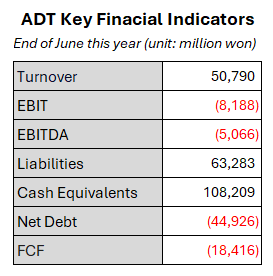
According to the electronic disclosure system of the Financial Supervisory Service on the 23rd, ADE Technology recorded consolidated accounting sales of about 50.8 billion won in the first half of this year (cumulative), growing by about 32% year-on-year. Operating loss was approximately KRW 8.2 billion, narrowing the loss compared to KRW 11.7 billion in the same period last year.
With a net loss, cash flow from operating activities resulted in a net outflow of approximately KRW 12.6 billion. This is an improvement from the same period last year, which was a net outflow of 17.9 billion won, but operating profitability needs to improve further.
In the year’s second half, mass production sales will occur for the first time, and the sales volume may increase, ADTECHNOLOGY explained. Domestic fabless semiconductors, which have signed a development contract with AD, will begin mass production in the second half of the year at Samsung Electronics’ foundry (contract manufacturing). The sales structure of a design house is largely divided into two parts: development costs and mass production sales, and mass production sales are much larger than development.
This is the first time that mass production sales have been caught since the transition to DSP. In 2020, AD’s growth was curtailed after it transitioned from its status as a value chain partner (VCA) of Taiwan’s TSMC to Samsung Electronics’ DSP. In 2021, sales exceeded 300 billion won for the first time in history thanks to mass-production sales from customers who were already mass-producing products, but as mass-production sales began to decline, they plummeted to 164.2 billion won the following year and 100.2 billion won last year.
According to the semi-annual report, development sales are about 37.2 billion won and mass production sales are about 11.1 billion won, of which mass production sales are based on contracts signed during the VCA era. Depending on the success of the customer’s development and the timeline of mass production, there remains uncertainty about whether or when mass-production sales will be recognized. The company explains that starting with this first mass production, it is clear that the contribution of mass production sales will increase in the future.
The company has set a goal of achieving 1 trillion won in sales by 2030, and to achieve this, it needs to achieve 10-fold growth over the next seven years. An AD-Technology official said, “We have presented this year’s guidance (forecast) at 150 billion won, and it seems that it is possible,” adding, “The delayed development contract will also be recognized as it will be carried out in the second half of the year.”
AD’s main business is to be a design house that diagrams and delivers fabless designed codes to foundries by connecting various electrical signals so that they can be manufactured as actual chips in the factory. It also provides the design of the remaining parts of the fabless system-on-chip (SoC) except for the core chip design. It is also engaged in a turnkey business that is responsible for both packaging and inspection. In particular, it is known as a house with strengths in customized platforms in the fields of automotive, artificial intelligence (AI), and high-performance computer (HPC), and focuses on 2nm (nanometer, billionths of a meter) process tasks.